Category: HVAC System

Auto Added by WPeMatico

  • Hantavirus Prevention & HVAC Safety Tips in Florence, Arizona

    Breadcrumbs

    These links will help you get back to where you want to go faster.

    The Hidden Danger in Your Vents: Understanding Hantavirus and Protecting Your HVAC System in Florence, Arizona

    In the dry, rugged environment of the Arizona desert, sharing your home space with local wildlife is common. However, some visitors pose more than just an inconvenience—they carry serious health risks. Recent hantavirus outbreaks in early 2026 have raised awareness of this severe respiratory illness, especially for homeowners in Florence, Maricopa, and the East Valley. The primary culprit? Often, it’s the very system designed to keep your home comfortable: your HVAC air ducts.

    What you will learn in this article:

    • Hantavirus Pulmonary Syndrome (HPS) is a serious respiratory illness carried primarily by deer mice in the Arizona desert, including Florence, AZ.
    • The virus spreads mainly through inhalation of aerosolized particles from rodent droppings, urine, or nesting materials, which can contaminate HVAC air ducts.
    • Rodents are attracted to HVAC systems because they provide shelter, warmth, and water, making ducts vulnerable to infestation and contamination.
    • Rodents nesting inside HVAC ducts can spread harmful particles throughout a home via the blower fan.
    • Key prevention steps include: air duct cleaning, sealing HVAC penetrations, maintenance and upgrading filtration systems.
    • Allstate Air and Heating, LLC offers specialized HVAC inspection, professional duct cleaning, sealing services, filtration upgrades, and coordination with pest control to protect Florence homes.
    • Homeowners should seek immediate medical attention if experiencing flu-like symptoms progressing to breathing difficulties after rodent exposure.

    Looking for a local, reliable and trustworthy HVAC Company? Allstate Air & Heating, LLC. is licensed for AC Installation, AC Repair, Smart Thermostat Installation, Air Duct Cleaning, Air Duct Repair and Dryer Vent Cleaning. For a free estimate call: 480-704-4828 or schedule an appointment online.
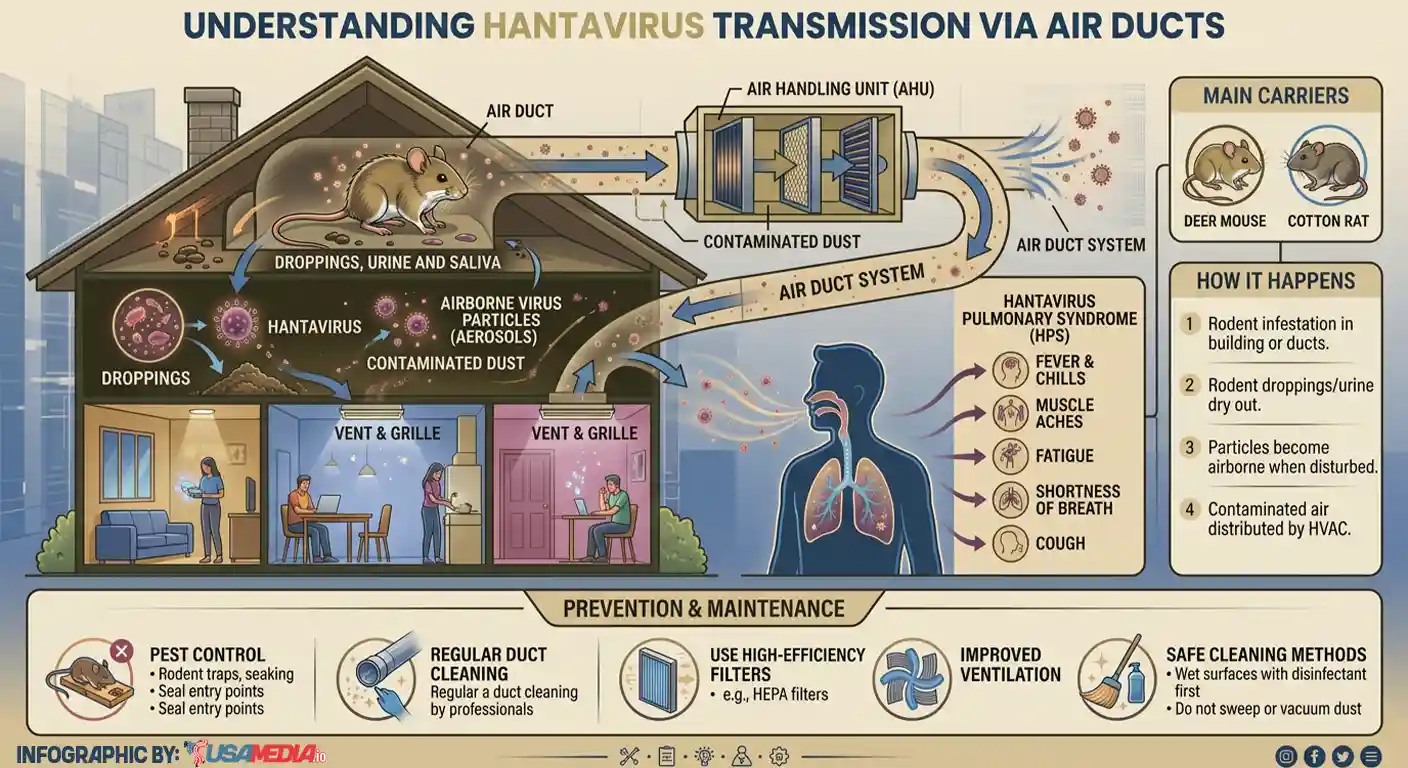
    How Hantavirus Spread Through Air Ducts

    What Is Hantavirus and Why Should You Be Concerned?

    Hantavirus Pulmonary Syndrome (HPS) is a serious respiratory disease that can sometimes be fatal. In the Southwest, this virus is most commonly carried by deer mice. Unlike many viruses, hantavirus is rarely transmitted from person to person. Instead, the primary route of infection is through inhalation of aerosolized viral particles.

    When rodent droppings, urine, or nesting materials are disturbed, microscopic viral particles become airborne. If these airborne particles enter your HVAC system, they can be distributed throughout your home, increasing the risk of inhalation.

    Why Your HVAC System Is Vulnerable to Rodent Contamination

    Rodents seek three basic needs: shelter, warmth, and water. Your HVAC system provides all three:

    • Ideal Nesting Areas: Insulated ducts offer a soft, dark, and warm environment, perfect for rodents to build nests.
    • Easy Entry Points: Small gaps in wall penetrations or loose duct connections serve as open doors for desert rodents.
    • The “Super-Spreader” Effect: Rodents nesting inside return air ducts can turn your blower fan into a distribution system for dander, droppings, and dried waste particles, pushing contaminants throughout your living spaces.

    Protecting Your Florence Home: Practical Steps to Reduce Hantavirus Risk

    Living in rural or desert-fringe areas like Florence makes rodent-HVAC interactions more likely. Here are effective ways to minimize risk and safeguard your home:

    1. Professional Air Duct Cleaning

    If you notice rodent droppings, scratch sounds, or a strong musky odor, a simple vacuum won’t suffice. Professional air duct cleaning removes debris and nesting materials that harbor harmful pathogens. At Allstate Air and Heating, we use industrial-grade equipment and HEPA containment protocols to thoroughly sanitize your ductwork.

    2. Seal All HVAC Penetrations

    Rodents can squeeze through holes as small as a nickel. It’s essential to seal gaps where refrigerant lines, electrical conduits, and vents penetrate walls. Using steel wool combined with high-quality silicone caulking around exterior units and vents can prevent rodent entry before infestations develop.

    3. Regular HVAC System Maintenance

    Routine HVAC tune-ups are vital to spot early signs of rodents, such as chewed wiring or shredded insulation, that many homeowners overlook. Early detection not only protects your system from costly damage but also reduces health risks.

    4. Upgrade to High-Efficiency Filtration

    Installing filters with a MERV rating of 13 or higher helps capture smaller airborne particles. While no filter can entirely eliminate viruses, enhanced filtration reduces the biological load circulating in your indoor air.

    In-Duct UV-C Germicidal Lights: UV-C light has been used for decades in hospitals to sterilize equipment. When installed inside your air handler, these lights target the DNA and RNA of bacteria, mold, and viruses—including Hantavirus. By damaging their genetic blueprint, UV-C lights prevent these microorganisms from replicating or causing infection.

    Bipolar Ionization Systems: Ionization systems, such as the iWave, work by releasing positive and negative ions into the air stream. These ions cause tiny sub-micron particles (like viral pathogens and dust) to clump together. Once they are “bundled” into larger clusters, they are easily caught by your HVAC filter or fall out of the air entirely, significantly reducing the amount of airborne contaminants.

    The REME HALO®: The Gold Standard in Air Purification: For the ultimate level of protection, we recommend the REME HALO®. Unlike passive technologies that wait for air to pass through them, the REME HALO® actively sends out hydro-peroxide plasma throughout your entire living space.

    • Kill at the Source: It neutralizes 99% of bacteria, mold, and viruses on surfaces and in the air.
    • Whole-Home Coverage: A single unit can purify every cubic inch of air that your HVAC system reaches.
    • Odor & VOC Removal: Beyond biological threats, it effectively eliminates smoke, cooking odors, and chemical vapors.

    How Hantavirus Spreads and Why It Matters for Your Home

    Hantavirus is transmitted primarily through inhalation of dust contaminated with infected rodent urine, droppings, or nesting materials. Secondary infections may occur through direct contact with contaminated surfaces or, rarely, through rodent bites. Person-to-person transmission is extremely uncommon and has only been documented with the Andes virus in South America.

    Rodents typically nest in attics, crawl spaces, furnace rooms, and duct plenums. Disturbing these areas during maintenance or cleaning can aerosolize contaminated dust and spread the virus through your duct system, potentially exposing all rooms in your home.

    Safe and Effective Risk Reduction Strategies

    Following recommended guidelines can greatly reduce hantavirus risks:

    • Seal and Secure Entry Points: Close gaps around pipes, vents, and foundation cracks. Screen attic vents and seal holes larger than ¼ inch.
    • Pre-Inspection: Before any duct cleaning or HVAC work, inspect for rodent droppings, nests, dead rodents, or tracks. If heavy contamination is detected, follow strict cleanup protocols.
    • Safe Cleanup Practices: Avoid dry sweeping or using standard vacuums without HEPA filtration. Wear gloves and an N95 respirator, ventilate the area, spray droppings with disinfectant, and dispose of waste securely. Professional cleanups are strongly recommended.
    • Containment During Service: Use negative-pressure HEPA exhaust and localized containment when servicing contaminated areas. Replace or disinfect affected duct sections as required.
    • Filter Upgrades and Maintenance: Install and regularly replace high-efficiency filters suitable for your system. Always handle used filters wearing protective gear.
    • Ongoing Rodent Control: Remove attractants such as pet food and open trash, trim vegetation away from the house, store firewood off the foundation, and consider licensed pest control services.

    The Role of Allstate Air and Heating, LLC in Protecting Florence Homes

    Allstate Air and Heating, LLC offers expert HVAC and air quality solutions tailored for Florence and nearby communities:

    • Comprehensive inspections focusing on rodent entry points, contamination, and equipment damage.
    • Professional air duct cleaning using HEPA-grade containment and industry-standard sanitization procedures.
    • Attic and duct sealing, vent screening, and recommendations on appropriate filter upgrades (MERV or HEPA).
    • Coordination with licensed pest control professionals for infestation cleanup and prevention.

    When to Seek Medical Attention

    If you develop flu-like symptoms—fever, muscle aches, fatigue—that progress to shortness of breath, especially after known rodent exposure or cleaning activities in rodent-infested areas, seek immediate medical care. Early diagnosis is critical as HPS can rapidly worsen and become life-threatening.

    Stay Safe and Proactive: Protect Your Family and Home

    In Florence and throughout Arizona, hantavirus is a rare but serious threat. Being informed, proactive, and working with professionals to maintain your HVAC system and control rodents provides the best defense.

    Looking for a local, reliable and trustworthy HVAC Company? Allstate Air & Heating, LLC. is licensed for AC Installation, AC Repair, Smart Thermostat Installation, Air Duct Cleaning, Air Duct Repair and Dryer Vent Cleaning. For a free estimate call: 480-704-4828 or schedule an appointment online.

    Frequently Asked Questions

    K
    L
    What is hantavirus and how is it transmitted?

    Hantavirus Pulmonary Syndrome (HPS) is a serious respiratory illness primarily carried by deer mice in the Arizona desert. It is transmitted mainly through inhalation of aerosolized particles from rodent droppings, urine, or nesting materials.

    K
    L
    Why are HVAC systems vulnerable to rodent contamination?

    HVAC systems provide rodents with shelter, warmth, and water. Insulated ducts offer ideal nesting areas, and small gaps or loose duct connections allow rodents to enter, potentially contaminating the system with harmful particles.

    K
    L
    How can hantavirus spread through my home via the HVAC system?

    Rodents nesting inside air ducts can cause the blower fan to distribute contaminated dust, droppings, and dried waste particles throughout the entire home, increasing the risk of inhaling viral particles.

    K
    L
    What preventative measures can homeowners take to reduce hantavirus risk in their HVAC systems?

    Homeowners should ensure professional air duct cleaning, seal all HVAC penetrations to block rodent entry, perform regular HVAC maintenance, and upgrade to high-efficiency filtration systems with a MERV rating of 13 or higher.

    K
    L
    Are there technologies that can help reduce airborne viral particles within HVAC systems?

    Yes, installing in-duct UV-C germicidal lights, bipolar ionization systems like the iWave, or advanced air purifiers like the REME HALO® can reduce bacteria, mold, viruses, and odors by sterilizing or neutralizing airborne contaminants.

    K
    L
    What steps should be taken if rodent contamination is suspected in HVAC ducts?

    It is important to avoid dry sweeping or using standard vacuums, wear protective gear including gloves and an N95 respirator, ventilate the area, spray droppings with disinfectant, and seek professional cleanup services.

    K
    L
    When should someone seek medical attention related to hantavirus?

    If flu-like symptoms such as fever, muscle aches, and fatigue progress to shortness of breath after known or suspected exposure to rodents or contaminated areas, immediate medical care is essential due to the risk of severe illness.

    K
    L
    How does Allstate Air and Heating, LLC help protect homes from hantavirus risks?

    We provide comprehensive HVAC inspections focused on rodent entry and contamination, professional duct cleaning with HEPA containment, sealing and vent screening services, filter upgrade recommendations, and coordination with pest control professionals.

    K
    L
    Is person-to-person transmission of hantavirus common?

    No, person-to-person transmission is extremely rare and has only been documented with the Andes virus in South America, not in the Arizona hantavirus strain.

    K
    L
    Can upgrading HVAC filters completely eliminate hantavirus from indoor air?

    No filter can entirely eliminate viruses, but installing filters with a MERV rating of 13 or higher helps reduce the amount of airborne viral particles circulating in indoor air.

  • 9 Critical Reasons Why Your AC Unit Is Not Working (And How to Fix Them)

    Breadcrumbs

    These links will help you get back to where you want to go faster.

    Why is my Air Conditioning Unit not working?

    Top 9 Reasons and How To Fix Them

    When your AC unit is not working, it can quickly turn a comfortable home into an uncomfortable space, especially during the sweltering summer months. Understanding the common issues that cause air conditioning problems is key to avoiding costly repairs and ensuring your cooling system runs efficiently. Whether you live in Florence Arizona, Queen Creek Arizona, Chandler Heights Arizona, or Coolidge Arizona, recognizing these 9 reasons why your AC unit may be malfunctioning will empower you to take timely action, saving both time and money. Professional HVAC repair services like Allstate Air and Heating provide skilled assistance to keep your home cool and comfortable all year round.

    What you will learn in this article:

    – Air conditioning units may stop working due to common issues like thermostat problems or dirty filters and ducts, especially in hot climates such as various cities in Arizona.

    – Lack of maintenance can cause poor performance; tune-ups and cleaning, especially in dusty desert climates, help maintain efficiency and prolong system lifespan.

    – Professional HVAC services like Allstate Air and Heating in Arizona provide specialized repair, maintenance, and installation tailored to local climate conditions.

    – Regular maintenance and prompt professional repairs can save money, extend AC lifespan, and keep homes comfortable during extreme heat.

    Looking for a local, reliable and trustworthy HVAC Company? Allstate Air & Heating, LLC. is licensed for AC Installation, AC Repair, Smart Thermostat Installation, Air Duct Cleaning, Air Duct Repair and Dryer Vent Cleaning. For a free estimate call: 480-704-4828 or schedule an appointment online.

    Common Causes of AC Unit Issues

    Thermostat Settings Malfunctions

    One of the simplest reasons for your air conditioning not working can be incorrect thermostat settings. If the thermostat is set too high, your system won’t activate when needed. Conversely, a faulty thermostat might fail to send the proper signal to the AC unit to start cooling. With proper calibration and regular checks, you can avoid thermostat-related AC problems. If you’re uncertain, trusted AC repair professionals such as those at Allstate Air and Heating can inspect and recalibrate your thermostat to keep your system running smoothly.

    Dirty Air Filters and Air Duct Problems

    AC units rely heavily on clean airflow to function efficiently. When air filters become clogged with dust and debris, restricted airflow causes the AC to work harder or even stop working altogether. Moreover, dirty air ducts filled with dust negatively impact system efficiency and indoor air quality. Scheduling routine air duct cleaning and consistently replacing air filters are effective preventive measures against common AC issues.

    For optimal performance, change filters every 60 days, or monthly if you have allergies or live in hot, dusty regions like Florence Arizona or Coolidge Arizona. Using higher filtration air filters can capture more dust and allergens, enhancing indoor air quality. However, be mindful that overly dense filters might restrict airflow to the compressor — testing filter strengths helps balance efficiency and cleanliness based on your home’s needs.

    Helpful tips related to dirty AC units, ducts, and vents include:

    – Clean air ducts every 3-5 years to support system efficiency. (Typical cleaning costs range from $450 to $1,000 depending on home size and number of units.)

    – Schedule more frequent cleaning if you have pets, allergies, asthma, recent home renovations, or pest concerns.

    – Address mold, odors, or excessive dust around vents immediately.

    – Replace HVAC filters every 1-3 months and vacuum around vents regularly.

    – Seal duct leaks, manage humidity, and schedule yearly HVAC maintenance for top performance.

    Refrigerant Leaks

    Refrigerant is essential for your AC unit to absorb heat and cool your home effectively. A refrigerant leak reduces cooling capacity and forces your system to run longer, leading to increased wear and higher energy bills. Warning signs include hissing sounds and noticeable drops in cooling performance. Expert HVAC repair technicians like Allstate Air and Heating in Chandler Heights Arizona can locate and repair refrigerant leaks promptly, restoring your AC’s efficiency.

    Recharging refrigerant involves refilling the current refrigerant and typically costs between $200 and $900 for the common R-410A type. Replacing the refrigerant—removing all old refrigerant and installing new—carries costs upwards of $1,800, especially with the discontinued R-22 type. Compressor repair fees add additional costs, ranging from $100 to $250 for parts, plus labor and service fees, which vary by region.

    Electrical Failures and Component Wear

    AC units are composed of numerous electrical components, such as capacitors, contactors, and fuses, that can deteriorate over time. These electrical failures frequently result in complete system shutdowns or unreliable operations. Regular HVAC inspections and professional AC repair services can identify and replace worn components before they cause major breakdowns, helping avoid emergency expenses.

    Clogged Condenser Coils

    The condenser coils dissipate heat from the refrigerant to the outside air, a vital part of the cooling cycle. When these coils become clogged with dirt and debris, heat exchange is compromised, lowering your unit’s cooling efficiency. This is a common culprit behind AC troubles. Professional air conditioning repair or swamp cooler installation services available in your area can clear clogged coils, optimize system performance, and extend your unit’s lifespan.

    Looking for a local, reliable and trustworthy HVAC Company? Allstate Air & Heating, LLC. is licensed for AC Installation, AC Repair, Smart Thermostat Installation, Air Duct Cleaning, Air Duct Repair and Dryer Vent Cleaning. For a free estimate call: 480-704-4828 or schedule an appointment online.

    Drainage Issues and Water Leaks

    AC units generate condensation that should drain away properly. However, a clogged drain line or damaged pan can cause water leaks and may eventually lead to system shutdowns. Regular maintenance that includes dryer vent cleaning, swamp cooler installation, and inspection of drainage components can help prevent these issues, protecting your home from water damage.

    Tripped Float Switch

    Most air conditioners come with a float switch safety device designed to prevent water damage to your home. This switch automatically turns off the AC when the drain pan risks overflowing, triggered typically by a clogged drain line. If water can’t drain correctly, it accumulates in the pan, activating the float switch and shutting off your system. Spotting a full drain pan is often a clear indication of this safety feature in action, explaining why your AC isn’t running properly.

    AC Unit Compressor Problems

    Compressors usually last between 10 to 15 years before showing signs of failure. If your compressor begins malfunctioning, deciding between repair or replacement depends mostly on cost-effectiveness. When repair costs surpass half the price of a new compressor or your entire system is aging, replacement typically makes more sense.

    Common signs needing compressor attention include:

    – Strange noises such as grinding, clunking, banging, hissing, or persistent humming.

    – Reduced cooling capacity owing to pressure maintenance issues.

    – Frequent rapid cycling of the unit switching on and off.

    Repair expenses for compressors vary from $800 to $2,800 depending on unit size and model. Smaller repairs like capacitor replacements cost between $90 and $475. Most homeowners pay between $1,200 and $2,600 for compressor replacement. Costs can be influenced by warranty status, local labor rates, and whether your system is high-end or standard. When replacing the compressor exceeds 50% of a new energy-efficient system’s cost, purchasing a new AC unit usually offers more value in the long term.

    AC Unit Overdue for Maintenance and Cleaning

    Sometimes, an underperforming or non-functioning AC unit is simply dirty. Routine maintenance, often called a tune-up, typically costs between $100 and $300 for most residential systems. In desert climates like Queen Creek Arizona or Coolidge Arizona, dust accumulation requires more frequent or intensive cleaning, pushing costs to $250–$400 or more. Regular cleaning and preventative maintenance extend the lifespan of your AC and optimize efficiency.

    Why Choose a Professional HVAC Service in Your Area?

    For dependable cooling system performance, rely on trusted HVAC repair specialists who grasp the unique climate challenges of Arizona. Companies such as Allstate Air and Heating provide comprehensive HVAC repair, AC repair, and installation services throughout Florence Arizona, Queen Creek Arizona, Chandler Heights Arizona, and Coolidge Arizona. Whether you require swamp cooler installation, air duct cleaning, or complex AC troubleshooting, professional service providers protect your investment and ensure your home stays comfortably cool.

    Looking to Get Your AC Unit Fixed?

    AC issues stem from many sources, ranging from simple thermostat mis settings to intricate electrical failures. Being aware of these 9 critical reasons your AC unit may not be working and investing in regular maintenance—including air conditioning repair, AC installation, and routine air duct cleaning—will extend the lifespan of your system and keep your indoor environment comfortable. When facing AC troubles, a seasoned HVAC repair team like Allstate Air and Heating is just a phone call away, ready to deliver prompt, dependable solutions tailored to your specific needs.

    Looking for a local, reliable and trustworthy HVAC Company? Allstate Air & Heating, LLC. is licensed for AC Installation, AC Repair, Smart Thermostat Installation, Air Duct Cleaning, Air Duct Repair and Dryer Vent Cleaning. For a free estimate call: 480-704-4828 or schedule an appointment online.

    Frequently Asked Questions

    K
    L
    Why is my air conditioning unit not working?

    Common reasons include incorrect thermostat settings, dirty air filters or ducts, refrigerant leaks, electrical failures, clogged condenser coils, drainage problems, tripped float switches, compressor issues, and lack of regular maintenance.

    K
    L
    How can thermostat issues affect my AC’s performance?

    If the thermostat is set too high or is faulty, it may prevent the AC unit from activating or sending the proper signal to start cooling. Regular calibration and professional inspection can resolve these problems.

    K
    L
    How often should I replace air filters to maintain efficient AC operation?

    Filters should be replaced every 60 days under normal conditions, or monthly if you have allergies or live in hot, dusty areas such as Florence or Coolidge, Arizona.

    K
    L
    What are the signs of a refrigerant leak in my AC unit?

    Signs include hissing sounds and a noticeable decrease in cooling performance, which signal the need for professional detection and repair.

    K
    L
    How much does it typically cost to recharge or replace refrigerant in an AC system?

    Recharging refrigerant usually costs between $200 and $900 for common types like R-410A, while replacing refrigerant can cost over $1,800, especially for discontinued types like R-22.

    K
    L
    What role do clogged condenser coils play in AC problems?

    Clogged coils reduce heat exchange efficiency, causing the AC to cool poorly. Cleaning coils professionally improves performance and extends system life.

    K
    L
    What causes the float switch to trip and shut off the AC unit?

    A clogged drain line causes water to accumulate in the drain pan, triggering the float switch, which shuts off the system to prevent water damage.

    K
    L
    How do compressor problems affect my air conditioning system?

    Compressor issues can cause strange noises, reduced cooling capacity, and frequent cycling on and off. Repair or replacement decisions depend on cost-effectiveness and system age.

    K
    L
    Why is regular AC maintenance important, especially in desert climates like Arizona?

    Routine maintenance helps prevent dust buildup, prolongs system lifespan, maintains efficiency, and reduces repair costs caused by harsh, dusty environments.

    K
    L
    Where can I find reliable HVAC repair services in Arizona according to the article?

    Trusted professionals such as Allstate Air and Heating offer repair, maintenance, and installation services in Florence, Queen Creek, Chandler Heights, and Coolidge, Arizona.

  • 2025-2026 HVAC Tax Credits & Rebates Guide

    Breadcrumbs

    These links will help you get back to where you want to go faster.

    How to Claim Your Federal Tax Credits & Arizona Tax Credits

    Including how to claim rebates from APS & SRP

    As the intense Arizona summer draws near, maintaining a cool and comfortable indoor environment is crucial. The extreme temperatures not only lead to discomfort within the home but can also pose serious health risks.

    Last summer, more than 608 deaths were attributed to heat-related issues, many of which involved individuals over the age of 60 who lived alone and had limited financial resources—or in some cases, lacked functioning air conditioning altogether.

    Allstate Air & Heating, LLC. wants to help you save big money with these tax credits and rebates for a new air conditioning unit, smart thermostat installation or air duct sealing service and call: 480-704-4828 or schedule an appointment online.

    Energy Star for Market Differentiation

    How Do I Get Tax Credits and Rebates For My New AC Unit?

    The Inflation Reduction Act (2022) offers federal tax credits for high-efficiency HVAC products meeting CEE Tier standards, excluding Advanced Tiers, through 2032. Choosing qualifying equipment can help homeowners reduce upfront costs via federal and state programs.

    How to Claim a Federal Tax Credit for a new AC Unit, Heat Pump or Air Duct Sealing

    The Energy Efficient Home Improvement Credit

    If you undertake certified energy-efficient upgrades to your residence after January 1, 2023, you may become eligible for a tax credit of as much as $3,200. This credit can be claimed for improvements completed through the year 2032.

    $600 for HVAC unit replacement credit per item

    $2,000 for Air Source Heat Pumps

    Up to $1,200 for Air Duct Sealing

    How can I maximize my tax credits?

    If replacing your old heating or cooling system with a new AC Unit or heat pump, first upgrade attic insulation to save on energy costs. Doing both in one year can earn you tax credits of up to $1,200 for insulation and $600-$2,000 for the heat pump.

    You can combine a heat pump installation ($2,000 credit) with window/door credits (up to $600 for windows, $500 for doors). Replacing your water heater later grants another 30% credit (up to $2,000) plus up to $600 for an electric panel upgrade or $1,200 for air duct sealing.

    Allstate Air & Heating, LLC. wants to help you save big money with these tax credits and rebates for a new air conditioning unit, smart thermostat installation or air duct sealing service and call: 480-704-4828 or schedule an appointment online.

    Federal Tax Credit FAQs

    Frequently asked questions about energy efficient home improvements and residential clean energy property credits. Go to the official IRS FAQs page for more information.

    K
    L
    What type of residence is required for the credit?

    Taxpayers can claim energy credits for installations in their U.S. principal residence they own and use; renters and second homes generally do not qualify, except for certain appliances and energy audits in rental or second homes used as residences. Homes not used as a residence are ineligible.

    K
    L
    May a taxpayer claim the federal tax credit if the property is also used for business purposes

    Eligibility depends on property use. If used exclusively for business, no credit. If qualifying and business use is ≤20%, the full credit applies. If business use exceeds 20%, the credit is based only on expenses for nonbusiness use.

    K
    L
    How can an individual taxpayer in a co-op or condominium determine their share of expenditures for qualified property when the co-op or management pays the expenses?

    Taxpayers in co-ops and condos can claim section 25C credits based on their proportionate share of expenditures for qualified property, with records maintained by governing bodies. Examples involve tenants and unit owners receiving credits for their respective shares paid for improvements like exterior doors.

    How to Claim an Arizona Tax Credit for a New AC Unit or Heat Pump?

    Home Electrification and Appliance Rebate (HEAR Program)

    Efficiency Arizona offers a HEAR rebate program through September 30, 2031 for qualified projects include the installation of Energy Star certified electric heat pumps for space heating and cooling (HVAC units and AC units). The incentive value is 100% of electrification project costs, up to $14,000, for low-income households, and 50% of costs, up to $14,000, for moderate-income households. There is a $500 incentive for project contractors per electrification project.

    $8,000 for Energy Star certified HVAC or AC unit installation/replacement or electric heat pumps

    Home Efficiency Rebate

    Through September 30, 2031 the home efficiency rebate program will subsidize fifty percent of the expenses for projects undertaken by households earning up to 150% of the local median income—approximately $154,000 annually for a family of four in Phoenix. For families whose income does not exceed 80% of the median, the full cost of such projects will be eligible for coverage.

    Arizona Home Efficiency Rebate Amounts

    How can I maximize my tax credit?

    These rebates can be used with other federal incentives depending on the project to lower costs even more. These rebates can be stacked if it uses the modeled approach (a method used to predict and analyze how energy is consumed within a system), not the measured approach.

    Below is a list of qualifying projects that you can take advantage of using the “Rewiring America Calculator”.

    • Up to $1,600 for weatherization including insulation, air sealing, or ventilation.
    • Up to $8,000 for Energy Star certified electric heat pumps for space heating and cooling.
    • Up to $1,750 for Energy Star certified heat pump water heaters.
    • Up to $840 for Energy Star heat pump clothing dryers.
    • Up to $840 for Energy Star electric kitchen equipment.
    • Up to $4,000 for electric breaker boxes.
    • Up to $2,500 for electric wiring.

    Allstate Air & Heating, LLC. wants to help you save big money with these tax credits and rebates for a new air conditioning unit, smart thermostat installation or air duct sealing service and call: 480-704-4828 or schedule an appointment online.

    Arizona Tax Credit FAQs

    Frequently asked questions about energy efficient home improvements and residential clean energy property credits. Go to the official Arizona Efficiency page for more information.

    K
    L
    When and how are rebates issued

    Rebates are factored into the contractor’s invoice, directly reducing the overall project expenses in accordance with the applicable rebate amounts eligible for deduction.

    K
    L
    Will I be reimbursed for previously completed projects

    This is a point-of-sale rebate initiative; therefore, reimbursements or retroactive rebates are not applicable. Only those projects that have received formal approval under the program are eligible to receive rebates, and they must be carried out by contractors who are qualified through Efficiency Arizona.

    K
    L
    Is financing available

    Efficiency Arizona itself does not offer or facilitate any form of financing. However, Allstate Air & Heating, LLC. does!

    K
    L
    How do I apply for the HEAR program

    If you are a homeowner and currently do not have a heat pump, click here to apply.

    How to Claim the APS New Air Conditioner Unit Rebate

    Arizona Public Service (APS) electrical company has a AC unit rebate program you don’t want to miss out on! To qualify for the rebate, Allstate Air & Heating, LLC. will submit the rebate form on your behalf and you must meet the following rebate requirements:

    Replace your failed or failing AC unit with a qualifying emergency replacement installed by an APS approved ac repair service contractor (rebate is available once per household). The homeowner must be enrolled in our Energy Support program, and the installation must meet APS standards.
    Rebate processing takes 6-8 weeks from the time your contractor submits paperwork to APS.

    $200 for AC unit replacement

    $1000 for AC unit replacement for customers in need

    $250 for air ductwork repair and sealing

    How to Claim the SRP New Air Conditioner Unit Rebate

    The Salt River Project (SRP) offers an air conditioning rebate and residential rebate initiative that presents a worthwhile opportunity for savings you won’t want to overlook. To qualify for the rebate, Allstate Air & Heating, LLC. will submit the rebate forms on your behalf. If you’re considering a new AC unit, heat pump or mini-split system, the SRP Cool Cash™ Rebate can help lower your costs.

    Here are some signs that it’s time to upgrade:

    • Your equipment is 10-plus years old.
    • Your system is extra noisy.
    • Your unit runs longer to maintain the same thermostat setting.

    Up to $1,125 for new AC unit replacement, heat pump or mini split system.

    Up to $100 for a new smart thermostate installation

    Up to $400 for air duct repair and air sealing service

    Allstate Wants To Make Air Conditioning Affordable For You & Your Family

    Arizona summers can reach beyond 100°F. During these extreme conditions, your current AC system might struggle to keep up, leading to uneven cooling, higher utility costs, and increased wear and tear. Upgrading to a new, energy-efficient air conditioning system can provide numerous benefits:

    Enhanced Cooling Efficiency: Modern AC units are designed to cool larger spaces more effectively while using less energy.

    Lower Energy Bills: Newer models consume less power, helping you save on monthly electricity costs.
    Improved Indoor Air Quality: Advanced filtration systems can reduce dust, allergens, and pollutants, creating a healthier indoor environment.

    Long-Term Reliability: Investing in a new AC can reduce the likelihood of unexpected breakdowns during peak summer heat.

    The federal and Arizona tax credits, along with APS and SRP rebates, cover various energy-efficient projects.

    • High-efficiency electric heat pumps
    • Central air conditioners
    • Duct and attic air sealing
    • Added attic insulation

    Allstate Air & Heating, LLC. wants to help you save big money with these tax credits and rebates for a new air conditioning unit, smart thermostat installation or air duct sealing service and call: 480-704-4828 or schedule an appointment online.

    Checklist for Claiming Your Tax Credits & Rebates

    Gather Your Documentation: Keep detailed records of all receipts and invoices related to your HVAC system purchase and installation, including information such as brand, model number, and Energy Star certification. These documents are essential proof when claiming tax credits and can help you access potential financial benefits.

    Know the Deadlines: Most tax credits require you to file within the same tax year that your installation was completed. Keep track of all deadlines to avoid missing them, as they can come up quickly—much like the sudden onset of a monsoon season.

    Professional Installation and Compliance: To qualify for HVAC tax incentives, your installation must be done with care and precision, just like the equipment itself. That’s why choosing a professional installer is crucial.

    • Precision Matters: Allstate Air & Heating, LLC. knows the proper way to install an HVAC system, ensuring it operates at peak efficiency. It’s not just about comfort; it’s about making sure every bit of energy is used efficiently, maximizing your savings and eligibility for tax credits.
    • Code Compliance: Consider local building codes as the essential rules for construction projects. Allstate Air & Heating, LLC. is well-versed in these regulations, ensuring your installation complies with all standards. This helps you meet the necessary requirements and qualify for applicable tax incentives.
    • Manufacturer’s Blessing: HVAC systems must meet specific installation criteria to maintain their warranty. Allstate Air & Heating, LLC. strictly follows these standards, providing peace of mind by ensuring the setup matches the manufacturer’s specifications and helps prevent future issues.
    Fill Out the Necessary Forms: Completing forms can often feel tedious, yet it is an essential component of the process. Be vigilant in ensuring you select and fill out the appropriate forms relevant to your specific tax credits. In particular, seek out IRS Form 5695 and verify that all details correspond accurately with your supporting documentation.

    Consult With A Tax Professional: Whenever uncertainty arises, consulting a taxation expert can be highly beneficial. They possess the knowledge to help you maximize all entitled credits and can provide guidance throughout the filing process, ensuring everything is handled accurately and efficiently.

    Submit and Track Your Credit: Once all necessary documents are reviewed and organized, proceed to submit your credit information alongside your tax return to the IRS. Afterward, exercise patience as the processing occurs. It’s advisable to monitor your credit status periodically, since these procedures can sometimes take a little time to finalize.

    Allstate Air & Heating, LLC. wants to help you save big money with these tax credits and rebates for a new air conditioning unit, smart thermostat installation or air duct sealing service and call: 480-704-4828 or schedule an appointment online.

  • Reduce Covid-19 with AC Air Purifier Technology

    Breadcrumbs

    These links will help you get back to where you want to go faster.

    Breath Healthier Air with Allstate Air & Heating, LLC.

    Reduce Covid-19 virus by 99.4%

    – Produces no ozone or harmful by-products and requires no UV light or replacement parts
    – Residential and commercial property owners are investing more time into HVAC air purification systems
    – Allstate Air & Heating, LLC. has access to the best technology on the market to purify the air you breathe in your home or business. Our technology does not use UV lights which can cause damage to human skin and eyes over long periods of time. It is state of the art technology inspired by nature.

    Looking for a local, reliable HVAC repair or replacement service? Call: 480-704-4828 or schedule an appointment online.

    Smart Technology Inspired by Nature

    Our ac air purifier uses ion technology, the same type of ions produced by lightening, waterfalls and ocean waves without developing any ozone. When these ions are injected into the air stream, they break down passing pollutants and gasses into harmless compounds like oxygen, carbon dioxide and water vapor.

    Using Science to Defeat Coronavirus Spread

    The technology we use is called iWave. It has been tested by innovative bioanalysis, a third party, independent bio-lab, and has produced amazing results.

    Reduces Covid-19 virus by 99.4%
    – 84.2% was inactive after 10-minutes
    – 92.6% was inactive after 15-minutes
    – 99.4% was inactive after 30-minutes

    Click Here Read Studies on This AC Air Purifier

    Protect Your Family with a Healthier and Smarter Way of Living

    With the spread of Covid-19, hospitals, businesses, and homes are looking at how to keep buildings clean from pathogens, bacteria, and viruses. Air conditioning technology and ac air purifier technology is gaining traction to curtail Covd-19 risks. The ac air purifier we use will retrofit to your existing AC unit – no need for expensive equipment or gutting your existing unit.

    The Springs Living company with 18 senior-living communities throughout Oregon and Montana, is looking to improve their buildings air filtration. “There’s a lot of new technology out there – and a lot of snake oil out there as well,” said Chris Shelby, the director of design for the McMinnville-based company.

    How To Safely Reopen Schools

    Families and businesses have the same sentiment as Chris Shelby. They are looking for a proven technology that will deliver results. Arizona schools are reopening, and everyone has the same concern, “how are we going to keep the teachers and kids safe?”

    “This is about making sure that our teachers, our staff, our kids and their families are safe,” said School Superintendent Kathy Hoffman. “My advice to all of our school leaders is to make sure they’re adhering to these as a matter of public safety.” With the technology Allstate Air & Heating, LLC. has access to, we can retrofit existing school buildings with ion air purifying technology that can reduce Covid-19 spread at schools.

    Arizona Leading Nation in Covid-19 Response

    Because Arizona is responding to Covid-19 with creative solutions and technology, we have been hailed by President Trump as the nation’s success story. Let us stay ahead of the nation and continue developing and deploying technology that keeps out homes and businesses healthier and safer.

    According to CNN, “(Arizona’s) turn around has caught the attention of health experts, who have praised Arizona as an example of a state that successfully reimplemented mitigation efforts as cases rose.”

    Looking for a local, reliable HVAC repair or replacement service? Call: 480-704-4828 or schedule an appointment online.

  • Arizona 2020 Energy Tax Credit Rebate Guide for AC Unit Installation

    Breadcrumbs

    These links will help you get back to where you want to go faster.

    Arizona 2020 Tax Credit and Rebate Guide for Energy Efficient AC Unit Installation is provided by Allstate Air & Heating, LLC.

    R22 refrigerant has been banned in Arizona meaning old AC units will eventually have to be replaced with new energy efficient units. Thousands of dollars are available to commercial and residential building owners through tax credits, incentives and rebates. President Donald Trump signs bill to restore geo tax credits through 2021 making it easier to install geothermal heating.

    Looking for a local, reliable HVAC repair or replacement service? Call: 480-704-4828 or schedule an appointment online.

    Old AC units using R22 refrigerant will eventually have to be replaced

    The EPA (Environmental Protection Agency) has completely banned the use of R22 because it is contributing to slow degradation of our ozone layer. This means that the majority of AC units in Arizona will have to be replaced with a new AC unit.

    Federal Tax Credits for New AC Unit, Heating Unit and Energy Efficient Upgrades

    The Bipartisan Budget Act passed in 2017 was an extension of tax credits for energy-efficient upgrades to your home. You can claim the following items on your taxes using IRS Form 5695: Residential Energy Credits.

    AC Unit and Heating Units $300 tax credit for Energy Star approved units. You can search for AHRI certified units here.

    Geothermal Heat Pumps are an amazing way that can save you up to 60% cost on heating and 50% off on cooling. This technology uses the earth’s natural heat and cooling to heat or cool your home. You can claim up to 26% off cost. Tax credit expires December 31 2021 and is available for both existing homes and new construction.

    Windows, Doors and Skylights means you can claim up to 10% of the cost or up to $200 for windows and $500 for skylights.

    A new roof that meets Energy Star requirements can earn you up to a rebate where you can claim up to 10% of the cost up or up to $500.

    Insulation to reduce air leaks like weather stripping, spray foam or house wrap, etc. can qualify you up to 10% of the cost, or at minimum $500 (product must have manufacturer’s certification statement).

    2020 SRP Rebate on New AC Unit or Heating Unit Installation

    Arizona summer heat is unbearable and can be deadly. That is why SRP is willing to give you a $1,125 rebate for installing a new energy-efficient AC, heat pump or mini split system.

    Hurry, this rebate is only available until Feb. 1 2019

    AC rebate requirements in order to participate include:

    – Must be a permanent SRP customer
    – Must have qualified system installed by a licensed contractor before April 30, 2020
    – Replace or supplement existing central heat pump or central AC unit
    – Submit Manual J load calculations with your applcation
    – Allow, upon request, SRP or our agent to inspect the installed unit to verify compliance
    – Click here to download the Cool Cash rebate application.

    2020 APS Rebate on New AC Unit or Heating Unit Installation

    If your AC unit or heat pump is more than a decade old you may be eligible for an APS rebate of $200. It’s as easy as having a licensed contractor submit the rebate after replacing your old system with a new energy-efficient one.

    The unit must be installed according to APS Quality Installation Standards with a minimum of 15 SEER.

    You will also save up to 20% annually than a customer who does not use a participating APS contractor.

  • R22 Refrigerant Becomes Illegal in Arizona – What Should You Do?

    Breadcrumbs

    These links will help you get back to where you want to go faster.

    The Environmental Protection Agency Bans R22 in 2020

    Over the last few years the EPA has been phasing out R22, a refrigerant that has the capability of depleting the ozone layer of Earth’s atmosphere. It is said that it is helping to contribute to a larger “greenhouse effect”.

    Since the 1970’s, chemists and scientists have discovered a huge hole in the ozone layer above Antarctica. This lead to a huge push by the EPA and United Nations to restore the ozone layer.

    Looking for a local, reliable HVAC repair or replacement service? Call: 480-704-4828 or schedule an appointment online.

    Why is the Ozone Important?

    Our ozone layer is a protective barrier that shields us from harmful sun rays and outside elements from space. NASA has announced that in 2006 the ozone hole has doubled in size, “It is primarily caused by human-produced compounds that release chlorine and bromine gasses into the stratosphere.”

    The ozone layer is comprised of O2 or oxygen molecules. As these molecules reach higher and higher in our atmosphere the sun breaks them apart into free oxygen atoms. The free atoms then bond with unbroken O2 molecules and create our ozone.

    R22 and other halogenated hydrocarbons contain chlorine atoms. When these chlorine atoms reach the highest parts of the Earth’s atmosphere, it creates more O2 so that the free atoms no longer have unbroken O2 molecules to bond with.Earth’s Ozone Layer

    Essentially, the ozone is becoming so thin that it is creating a hole.

    The EPA Bans AC Units That Use R-22

    AC and Central Air Units manufactured before 2010 will become much more expensive to maintain and fix. The EPA warns consumers that “R-22 will become more limited and that the price will increase”.

    That means, when you call anyone to repair your AC or heating unit and it uses R-22, you will pay much more than you normally pay to recharge your central air conditioning unit.

    Here is the EPA’s timeline for phasing out R22 from the United States

    – January 1st, 2010 Ban on production, import and use of HCFC-22 and HCFC142b, except for continuing servicing needs of existing equipment.
    – January 1st, 2015 Ban on production, import, and use of all HCFCs, except for continuing servicing needs of existing equipment.
    – January 1st, 2020 Ban on remaining production and import of HCFCs. After 2020, the servicing of systems with R-22 will rely on recycled or stockpiled quantities.
    – January 1st, 2030 Ban on remaining production and import of all HCFCs

    Allstate Air & Heating Can Help You Transition Away From R22

    Allstate Air & Heating can help you transition away from R22 and the massive costs that are one the way. There are a few things you should consider when making the decision to repair or replace your exiting central air conditioning and heating unit.

    Risk of Waiting

    The cost to repair and recharge any ac or heating unit using R22 will drastically increase.

    If you have an AC unit that is 10-20 years old it would be a wise move to replace it with a more energy efficient system that does not use R22

    Save money on energy bills! This goes hand in hand with the age of the system. The AC units that are being manufactured today can save you a lot of money on your energy bill.

    Looking for a local, reliable HVAC repair or replacement service? Call: 480-704-4828 or schedule an appointment online.

  • Queen Creek Witnesses Record Number of Heat Related Death

    Breadcrumbs

    These links will help you get back to where you want to go faster.

    Heat killed 172 people in the Phoenix and Queen Creek in 2021

    This is a record high for the major city and surrounding area, including Queen Creek and San Tan Valley. The most vulnerable during these hot days and nights include outdoor workers, the elderly, young children and even pets.

    Queen Creek and the valley of San Tan are becoming increasingly hotter places to live due to the combined effects of so called climate change and the local urban heat-island effect. For the past 15 years Queen Creek and Sant Tan Valley have seen a steady increase of new construction for homes and laying down of new concrete for walkways and roads to supplement its growing population.

    According to AccuWeather, Phoenix and its surrounding area is one of he hottest large cities in America. Phoenix alone has over one million residents and has temperatures that reach 90 degrees Fahrenheit and above for more than 67 days in an average year.

    Both Phoenix and Queen Creek, AZ share similar temperatures throughout the year. On average, these cities share an average high temperature of 105 degrees Fahrenheit in July and an average low of 41-42 degrees Fahrenheit in January in the shade.

    Looking for a local, reliable HVAC repair or replacement service? Call: 480-704-4828 or schedule an appointment online.

    Heat Related Death Prevention Tips:

    – Stay inside during hottest months. If you must go outside, try to plan short trips during the coolest parts of the day.
    – Plan ahead. Avoid too much activity in hot weather. Activity increases body temperature.
    – Eat smaller meals. Eating heavier and larger meals will increase your metabolism which will also increase internal body temperature.
    – Wear light-colored, loose-fitting clothing made of natural fibers (cotton and linen are best).

    – Put wet towels on head, take cool (not cold) showers and put feet in water.
    – Drink plenty of non-alcoholic liquids (cold) even if you’re not thirsty.
    – Keep HVAC system in top shape. Have a professional HVAC company inspect your A/C unit on a regular basis or before summer begins. (January through March are best for Queen Creek and San Tan residents).
    – Do NOT go outside ALONE during hot days (above 95 degrees Fahrenheit)
    – Check in on family, friends and neighbors who may be vulnerable to the heat (Call them at least once a day).
    – Never leave children, older people or pets in cars.

    Looking for a local, reliable HVAC repair or replacement service? Call: 480-704-4828 or schedule an appointment online.

  • 6 Simple Ways To Clean HVAC System

    Breadcrumbs

    These links will help you get back to where you want to go faster.

    Keep Your HVAC Unit Clean to Keep Your Utility Bill Cheap!

    Allstate Air & Heating knows how hard it is to keep HVAC units clean in Arizona. After all, we live in a desert and are surrounded by dirt!

    With average costs for HVAC cleaning in Arizona being anywhere from $100-$500 depending on how large the home is it may not be in your budget.

    Looking for a local, reliable HVAC repair or replacement service? Call: 480-704-4828 or schedule an appointment online.

    6 Steps For DIY HVAC Cleaners

    1 – Check air filters and replace as needed
    One of the most important things you should do is inspect your air filter. Dirty air filters make HVAC systems less effective and efficient because of the strain it causes. Remind yourself each month to check your HVAC air filter and replace it if it is dirty.

    2 – Replace air filters every 30-90 days
    Most people have pets and because of this hair and airborne dirt is floating around more than you think. Also, during the winter Arizona residents have their windows open and that causes more dirt to float around the home. All of this gets caught the filter and causes the HVAC to work harder.

    3 – Keep AC and Heat systems clean
    If you look at up at the air vents you will see dirt 9 times out of 10. This is because the airflow in the home is circulating dirt in and out of the air vents. Not only is it important to clean air filters but to clean the vents to maximize airflow throughout the house.

    4 – Shut the humidifier off
    Try not to run the humidifier all the time in order to give your HVAC system a rest. You can do this by turning of your furnace humidifiers water supply, or unplugging portable systems around the house during the summer. During the cooler months replace the water panel and keep humidity levels between 30-50 percent.

    5 – Listen for noises blocking air flow
    Go to each vent and listen to see if you hear of any noises. Usually this means that something is clogging the system. These noises could be from debris, loose bolts, hissing from air escaping from the system, etc.

    6 – Use fans more often
    Give your HVAC system a break and turn your fans on. If the heat is unbearable keep your air conditioning unit on running at 75-degrees and turn your fans on throughout the house. Check out these 8 simple ways to reduce your electric bill this summer.

    Looking for a local, reliable HVAC repair or replacement service? Call: 480-704-4828 or schedule an appointment online.

  • 5 HVAC Innovations That Will Change How Arizona Residents Cool and Heat Homes and Businesses

    Breadcrumbs

    These links will help you get back to where you want to go faster.

    New HVAC Technology Will Forever Change Your Home and Business

    Arizona energy prices are very high if you haven’t noticed! That is because we consume so much of it. President Trump has lifted restrictions on how energy companies can utilize more resources, like coal, in order to help lower costs. However, technology is also going to help Arizona residents save money by cutting down energy use in homes.

    Looking for a local, reliable HVAC repair or replacement service? Call: 480-704-4828 or schedule an appointment online.

    Motion Sensor Air Conditioning

    Smart temperature-control devices – such as thermostats that learn and adjust to pre-programmed temperatures are poised to increase comfort and save energy in homes.

    Technology companies have created smart vents homeowners install in a place of traditional vents and then plug a sensor into each room. The sensors constantly measure a rooms temperature and then relay that information to the hub which tells the vents when to open and close.

    Thermal Air Conditioning

    This new technology will take several years before commercial buildings begin utilizing this low-cost alternative. Thermally driven air conditioning systems use a unique blend of solar energy/solar panel technology and natural gas. These systems use a double effect chiller that uses high temperature at around 350F. Solar panels do not have the capability to produce that much energy or heat and so thermal energy panels are needed.

    Gas prices are the lowest they have ever been and electricity costs are sky rocketing. The mix between gas and solar make thermal air conditioning units the future of energy saving and cost saving for commercial buildings.

    Ice Powered Air Conditioning

    This amazing technology cuts down ac costs by 30%. The technology is reminiscent of a swamp cooler. A tank of water is cooled by night turning it into ice and then during the day the ice cools the refrigerant. That cool air is then blown into the house through the ventilation system.

    The technology is able to cool a home for up to 6-hours during the day which isn’t long enough yet – however the technology will continue to improve over time.

    Duel Fuel Heat Pumps

    This innovative design uses a combination of electric heat pump and gas furnace. At low temperatures the pump draws from gas heat because gas costs much less than electricity. So when the building is at its coldest the pump is using gas in order to efficiently and effectively warm the building. When temperature is at its highest the electricity pump takes over in order to maintain comfortability in the building.

    The initial cost to install a dual fuel heat pump is expensive but giving the savings over the years will more than make up it.

    Geothermal Heat Pumps

    Sometimes referred to as GeoExchange this technology gets its energy from the ground. These heating pumps use the temperature of the earth in exchange of outside temperatures.

    The EPA says “Like a cave, ground temperature is warmer than the air above it during the winter and cooler than the air in the summer. Geothermal Heat Pumps take advantage of this by exchanging heat with the ears through a ground heat exchange.

    Looking for a local, reliable HVAC repair or replacement service? Call: 480-704-4828 or schedule an appointment online.